-
Shop
- Adidas
- Advanced Technologies
- Auto
- Back to School
- Best-Sellers
- Car Accessories
- Dating & Social Skills
- Education & Learning
- Family & Parenting
- Fashion
- Alexander McQueen
- Balenciaga
- Belts
- Blazers
- Bottega Veneta
- Brunello Cucinelli
- Burberry
- Chanel
- Chloé
- Dior
- Dolce & Gabbana
- Etro
- Fendi
- Gucci
- Hoodies & Sweatshirts
- Jacquemus
- Jil Sander
- Jimmy Choo
- Kiton
- Luggage
- Miu Miu
- Off-White
- Outerwear
- Prada
- Rick Owens
- Saint Laurent
- Sweaters & Cardigans
- The Row
- Tom Ford
- Tops & Shirts
- Umbrellas
- Valentino
- Valentino Garavani
- Versace
- Vivienne Westwood
- Fashion Accessories
- Gadgets
- Gifts
- Health & Beauty
- Health & Wellness
- Home & Garden
- Home Supplies
- Kids & Babies
- Kitchen
- Nike
- Outdoor Fun
- Patio, Lawn & Garden
- Personal Growth
- Pet Care
- Pet Supplies
- Pets
- Sport & Outdoors
- Summer 2025 Fashion Collection
- Summer Fashion
- Summer Food & Drinks
- Super Deals
- Travel
- Travel Gear
- Wealth
Montessori Wooden Math Puzzle for Counting & Simple Sums
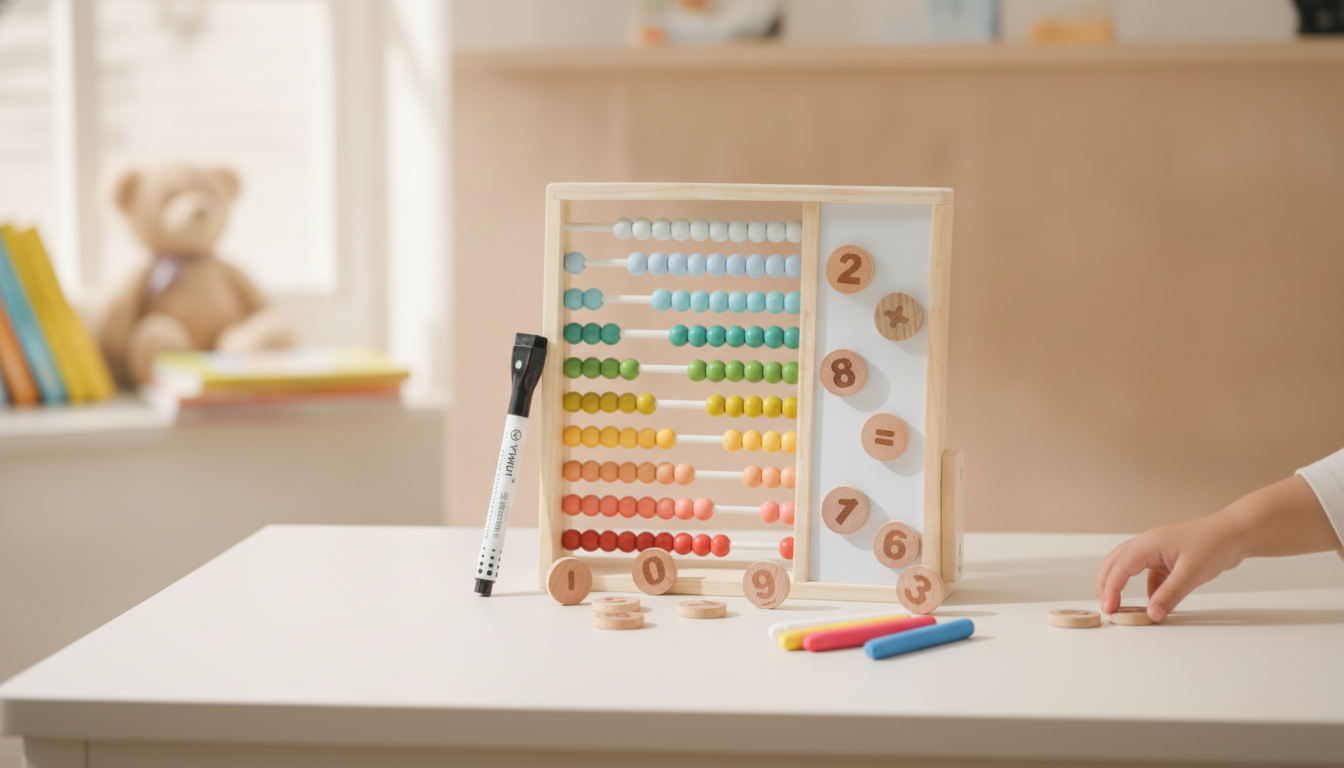
Wooden Montessori Arithmetic Puzzle: Hands-On Number Play for Early Learners
A wooden Montessori arithmetic puzzle turns early math into a tactile, confidence-building activity. With number pieces and simple operations, children practice counting, symbol recognition, and basic equations through repetition, self-correction, and independent play. The real value comes from moving little pieces with purpose—seeing “3” not as a squiggle to memorize, but as a quantity a child can build, compare, and combine.
What It Is and How It Supports Early Math
A Montessori-style arithmetic puzzle typically includes wooden numerals, operation symbols (like “+” and “−”), and an equals sign that fit into a board or tray. Children physically arrange pieces to create number sequences and simple equations, which helps transform abstract math into something they can touch and test.
- Hands-on number manipulation helps children connect quantities to symbols rather than memorizing abstract facts.
- Encourages self-directed practice: children can build equations, check their own work, and repeat at their own pace.
- Strengthens foundational skills: number recognition, one-to-one correspondence, sequencing, and early problem-solving.
- Promotes fine-motor control and visual tracking while arranging pieces and reading left-to-right.
- Fits Montessori-style learning principles: concrete materials first, then gradual movement toward mental math.
Play-based learning also supports attention, language, and confidence—benefits aligned with guidance from the American Academy of Pediatrics on the power of play.
Best Ages and Learning Stages
The same puzzle can grow with a child by changing the goal—not the tool. Start simple, then add challenge when your child is ready.
- Toddlers and preschoolers: start with counting, number matching, and ordering pieces from smallest to largest.
- Pre-K to kindergarten: introduce “+” and “−” as actions (adding pieces together, taking pieces away).
- Early elementary: practice simple equations, number bonds, and quick fact review using short daily sessions.
- Mixed-age households: set up different challenge levels by limiting the range of numbers or adding timed rounds for older children.
For guidance on age-appropriate expectations, the NAEYC’s Developmentally Appropriate Practice position is a helpful reference point.
How to Use the Puzzle: Simple Activities
Keep activities short and concrete, especially at first. A calm, repeatable routine often works better than long “lessons.”
- Number hunt: lay out numbers and ask the child to find and name each piece, then place them in order.
- Count-and-match: pair each numeral with a matching quantity using small objects (beans, pom-poms) beside the piece.
- Build an equation: choose two numbers and an operation, then let the child assemble a complete statement (e.g., 3 + 2 = 5).
- Missing piece challenge: build an equation with a blank spot and ask the child to find the missing number or symbol.
- Story problems: act out real-life situations (“You have 4 apples, eat 1…”) and translate them into a subtraction equation.
- Speed practice (optional): keep it playful—short bursts can help automaticity without pressure.
If your child makes an error, try pausing before correcting. In Montessori-aligned work, the adult aims to guide the setup, then let the child do the thinking. For a deeper look at Montessori principles and materials, visit the Association Montessori Internationale (AMI).
Key Features to Look For in a Wooden Math Puzzle
Not all wooden puzzles are made the same. A few practical design details can make daily practice smoother and safer.
- Clear, high-contrast printing or engraving that remains readable over time.
- Smooth edges and well-finished corners to reduce splinters and improve comfort.
- Pieces that are easy to grasp for small hands (thicker pieces are typically easier for beginners).
- A sturdy base or board that keeps pieces organized and helps children self-correct placement.
- Non-toxic materials and finishes appropriate for children’s products.
- Storage considerations: a built-in tray/slots can reduce lost pieces and make cleanup part of the routine.
Skill Progression Guide
A simple progression keeps math feeling logical (and prevents frustration). Start with what your child can see and touch, then move toward faster recall later.
Learning Goals by Stage
| Stage | Focus | Example Activity |
|---|---|---|
| Stage 1: Early counting | Recognize numerals and count with one-to-one matching | Place numbers 1–10 in order; count small objects to match each numeral |
| Stage 2: Intro to operations | Understand adding and taking away | Build 1–5 addition and subtraction stories with objects, then mirror with pieces |
| Stage 3: Early equations | Make and solve simple number sentences | Create 3 + 2 = 5, then swap to 2 + 3 = 5 to show commutativity |
| Stage 4: Fluency building | Practice facts and patterns with confidence | Do a “missing number” round: 6 − __ = 4, 1 + __ = 3 |
Care, Storage, and Safety Notes
Featured Items for a Calm, Screen-Free Learning Space
- Wooden Montessori Arithmetic Puzzle — a practical, screen-free math material designed for early counting and simple arithmetic practice.
- Elegant Irregular Oval Shaped Tabletop Mirror for Home Décor — useful for brightening a small learning shelf area and reflecting light near a work space.
- Handmade Glazed Ceramic Flower Pot — a simple way to add a small plant to a learning corner, reinforcing care routines and responsibility.
FAQ
What age is a wooden arithmetic puzzle best for?
Many families start around ages 2–3 for number recognition and counting, then continue through kindergarten and early elementary for addition and subtraction practice. Younger toddlers may need closer supervision, especially if they still mouth small objects.
How do Montessori math materials help children learn arithmetic?
They support a concrete-to-abstract path: children handle real pieces first, then gradually internalize the ideas. The design encourages repetition and self-correction, which builds number sense before relying on memorization.
How can a child practice addition and subtraction without worksheets?
Use the puzzle pieces to build equations, act out story problems with household objects, and play missing-number games for quick daily practice. Short, consistent sessions help skills stick without turning math into a chore.
Recommended for you

Was this article helpful?
Yes
No









Leave a comment